Agricultural & Bio-Environmental Engineering Technology

Dr. (Engr.) A. K. Bello
PhD (Agric Eng.), MSc, BEng — HODAgricultural & Bio-Environmental Engineering Technology
Our department integrates engineering and biological science to develop sustainable solutions for water, soil and farm mechanization challenges. We emphasize practical labs and industry-linked projects.
History
The Department of Agricultural & Bio-environmental Engineering was established in 2018 and obtained interim accreditation to commence National Diploma Programme in Agricultural & Bio-Environmental Engineering in 2020. Full accreditation was granted by the National Board for Technical Education in 2024.
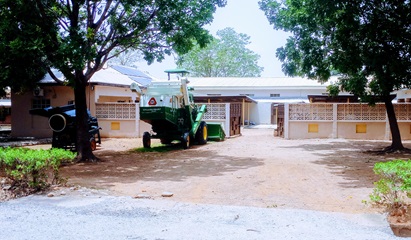
The agricultural & Bio-Environmental Engineering Department is headed by Dr Mohammed Abubakar Clarkson. The Department has fleet of tractors and other farm machineries. It also operates a commercial farm for the institution and current student’s enrolment stood at 15.
Goals and Objectives
The programme is designed to produce Agricultural Engineering Technicians capable of utilizing and carrying out repairs and routine maintenance of farm machinery, irrigation and drainage facilities as well as storage and processing equipment and who can assist in the design of farms, farm structures and other farm facilities.
Objectives
On the completion of the programme the diplomat of ND in Agricultural and Bio-environmental Engineering Technology should be able to:
- Operate, maintain and repair farm tractors, and other farm implements, tools equipment and machinery.
- Supervise and manage mechanized farms and farming operations.
- Construct and maintain small earth dams, drainage and water distribution system and structures for irrigation purposes.
- Carry out the construction and layout of contours, terraces, strip cropping for soil conservation purposes. Erect simple farm storage structures (silos, cribs, rhumbus etc.)
- Maintain and repair simple primary crop processing machines like sellers, decorticators, graters, milling machine, grinders etc. 7.0 Install, maintain and repair irrigation equipment.
- Design, maintain and repair electrical wiring systems in farm buildings and houses.
- Prepare brief technical reports on small scale farm enterprises.
- Prepare a farm survey plan and land capability classification of a farm.
Entry Requirements
Applicants may be considered for admission if they meet one of the following:
- At least a pass in English Language and Credit level passes in four subjects obtained in not more than two sittings in GCE ‘O’ Level, or Secondary School Certificates (SSCE). The four subjects include Mathematics, Physics, Biology/Agriculture Science or Chemistry and the other subjects.
- At least a pass in English Language and four credit passes in an NBTE recognized preliminary National Diploma Course offered in a Polytechnic or similar post-secondary technical institution. The credit passes must include Mathematics, Physics, Chemistry and biology.
Admission Requirements
- SSCE/GCE/NECO with credits in English, Mathematics, Physics, Chemistry and Agricultural Science/Biology.
- ND holders in related disciplines may be considered for HND entry.
- Successful applicants must pass departmental screening and meet the institution's general admission rules.
Structure of Programme
The National Diploma Agricultural and Bio-environmental Engineering Technology programme is a terminal programme and is structured to last for two years (four semesters). This include three to four months of supervised industrial work experience (SIWES) between the end of semester 2 and the beginning of semester.
Conditions of Award
The curriculum of the ND programme consists of three main components. These are:
Curriculum
The curriculum comprises three components:
- General Studies / Education
- Foundation Courses
- Professional Courses
The general education component shall include courses in arts and humanities – English Language, Communication, and history. These are compulsory. Mathematics and science (for non-Science based programmes) social studies – citizenship (the Nigerian Constitution) Political Science, Sociology, Philosophy, Geography, Entrepreneurship studies. The course in citizenship, Entrepreneurship, philosophy of Science and Sociology are compulsory. The general education component shall account for not more than 15% of total contact hours for the programme.
Foundation courses include courses in Economics, Mathematics, pure Sciences, Technical Drawing, and Descriptive Geometry, Statistics etc. the number of hours will vary with the programme and may account for about 10 – 15% of the total contact hours.
Professional courses are courses which give the student the theory and practical skills he needs to practice his field of calling at the technician/technologist level. These may account for between 60% - 70% of the total contact hours depending on programme.
Accreditation
Each ND programme must be accredited by the NBTE before diplomas are awarded. For details contact the Executive Secretary, Programmes Department, National Board for Technical Education, Plot B, Bida Road, P.M.B. 2239, Kaduna, Nigeria.
Guidance Note for Teachers Teaching the Programmes
The new curriculum is drawn in unit courses. This is keeping with the provisions of the national Policy of Education which stress the need to introduce the Semester credit units which will enable a student who so wish to transfer the units already completed in an institution of similar standard from which he/she is transferring.
In designing the units, the principle of the modular system by product has been adopted; thus making each of the professional modules, when completed provides the student with technician operative skills, which can be used for employment purposes. As the success of the credit unit system depends on the articulation of programmes between the institutions and industry, the curriculum content has been written in behavioural objectives, so that it is clear to all the expected performance of the student who successfully completed some of the courses or the diplomats of the programme.
There is a slight departure in the presentation of the performance based curriculum which requires the conditions under which the performance are expected to be carried out and the criteria for the acceptable levels of performance. It is a deliberate attempt to further involve the staff of the department teaching the programme to write their own curriculum stating the condition existing in their institution under which the performance can take place and to follow that with the criteria for determining and acceptable level of performance.
Departmental submission on the final curriculum may be vetted by the academic board of the institution. Our aim is to continue to see it that a solid internal evaluation system exists in each institution for ensuring minimum standard and quality of education in the programmes offered throughout the polytechnic system and similar post – secondary technical institutions.
The teaching of the theory and practical work should, as much as possible, be integrated. Practical exercises, especially those in professional courses and laboratory work should both be taught in isolation from the theory. For each course, there should be a balance of theory to practice in the ratio of 50:50 or 60:40 or the reverse.
Preview More on PDFProgrammes Offered
ND in Agricultural & Bio-Environmental Engineering Tech
HND in Agricultural Engineering Technology
Explore the Department